




 5.0
4.7
4.9
5.0
4.7
4.9
Losing a tooth can affect much more than your smile. Depending on where the tooth was lost, you may notice changes when chewing, speaking or biting. You might also become more aware of the gap when you smile. For some patients, replacing the tooth is simply about restoring appearance; for others, restoring comfortable function is the main priority.
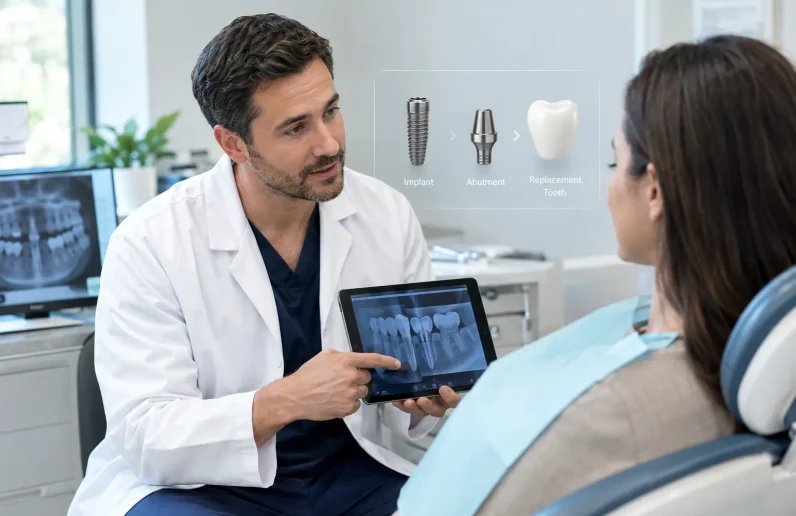
Dental implants are one option for replacing missing teeth. They use a small titanium implant placed into the jawbone to support a crown, bridge or, in some cases, a denture. However, implant treatment is not a single procedure. It is a planned process, and the exact stages depend on your oral health, the condition of the jawbone and the number of teeth being replaced.
If you are considering Dental Implants In Barnet, here is what the journey may involve.
The first stage is a detailed dental assessment. Your dentist will look at the area where the tooth is missing as well as the surrounding teeth and gums.
They may assess:
Dental X-rays and, where appropriate, three-dimensional scans may be used to examine the bone and the structures surrounding the proposed implant site.
This assessment matters because an implant needs healthy supporting tissues and careful positioning. If gum disease, infection or another dental problem is present, it may need to be addressed before implant treatment begins.
Once your dentist has assessed the area, they can discuss the available replacement options with you.
For a single missing tooth, an implant-supported crown may be suitable. If several teeth are missing, an implant-supported bridge could be considered. Patients who have lost many or all of their teeth may have other implant-retained options available.
Your dentist should explain the benefits, limitations, possible risks and alternatives rather than assuming that an implant is automatically the right choice.
The timing can also vary. Some patients can proceed after a tooth has been removed, while others need a period of healing first.
Before an implant is placed, your mouth needs to be in a condition where the treatment has a good foundation.
For example, existing gum disease may need treatment, and a damaged or infected tooth may need to be removed. In some cases, there may not be enough bone in the proposed implant area. A bone-grafting procedure may then be considered.
Not everyone needs additional procedures. Your dentist can explain whether preparation is necessary based on your examination and scans.
The implant itself is a small post, usually made from titanium, which is placed into the jawbone under local anaesthetic. Sedation may also be discussed for suitable patients who feel particularly anxious.
After placement, the surrounding bone gradually bonds with the implant. This biological process is known as osseointegration.
The healing period varies between individuals and treatment sites. Your dentist will tell you when the implant is ready for the next stage rather than relying on a fixed timetable for everyone.
Once the implant has integrated sufficiently with the bone, the next stage is to attach the replacement tooth.
For a single missing tooth, this is commonly an implant-supported crown designed to resemble your natural teeth. Your dentist and dental laboratory will consider factors such as the shape, colour and position of the tooth when creating the restoration.
The aim is not simply to fill the gap. The replacement needs to function appropriately with the rest of your bite.
A dental implant cannot develop tooth decay in the same way as a natural tooth, but that does not mean it is maintenance-free.
Plaque can still accumulate around the gum and implant, and inflammation around an implant can cause problems. Good daily cleaning, regular dental examinations and professional maintenance are therefore important.
Your dentist may recommend specific brushes, interdental cleaning aids or other techniques depending on your implant and surrounding teeth.
Smoking can also adversely affect oral health and implant treatment outcomes, so patients who smoke should discuss this honestly with their dental team.
A missing tooth itself is not usually a dental emergency, but the reason for tooth loss may require prompt attention. Pain, swelling, infection, bleeding or a recently damaged tooth should be assessed rather than simply ignored.
If you have sudden severe dental pain or significant swelling, an emergency dentist In Barnet may be appropriate for an urgent assessment. Severe facial swelling accompanied by difficulty breathing or swallowing requires urgent medical attention.
A Dentist In Barnet can assess the immediate problem and discuss longer-term options once your mouth is stable.
There is no single treatment time that applies to every patient. The process may take several months because the implant often needs time to integrate with the jawbone before the final restoration is fitted.
Treatment can take longer if tooth extraction, bone grafting, gum treatment or other preparatory procedures are required.
It is better to allow sufficient healing and planning than to rush the process. Your dentist should provide a treatment sequence based on your individual circumstances.
No. Although implants can be an effective way of replacing missing teeth, they are not suitable or necessary for everyone.
Alternatives can include bridges or removable dentures, depending on the number and position of missing teeth, the health of your remaining teeth and your preferences.
The right decision should consider your oral health, expectations, treatment requirements and long-term maintenance.
For patients in London considering Dental Implants In Barnet, the sensible first step is an individual assessment. Once your dentist understands why the tooth is missing and the condition of the surrounding tissues, they can explain which replacement options are realistic for you.
Implant placement is normally carried out under local anaesthetic, so you should not feel the procedure itself. Some discomfort, swelling or tenderness can occur afterwards and can usually be managed with the aftercare recommended by your dental team.
Sometimes an implant can be placed immediately after extraction, but this depends on factors such as the condition of the extraction site, available bone and the presence of infection. Your dentist will assess whether immediate placement is appropriate.
Implants are designed as a long-term tooth replacement, but their longevity depends on factors including oral hygiene, gum health, smoking, general health, biting forces and regular professional care. There is no guaranteed lifespan for an individual implant.
Active gum disease generally needs to be controlled before implant treatment is considered. Your dentist can assess your gums and recommend appropriate treatment before discussing implant placement.
The consequences vary depending on the tooth and your individual circumstances. A gap may affect chewing or appearance, while changes in tooth position can occur over time. Your dentist can explain the likely implications of leaving the space untreated.
Suitability can only be determined after an individual dental examination and appropriate imaging. Your dentist will consider your gums, bone, remaining teeth, medical factors, smoking status, expectations and alternative treatments before recommending an approach.

Gaurav Mehta is a Principal Dental Implantologist at GM Dental & Implant Centre and has been practising dentistry since graduating from Ajman University of Science and Technology in 2005. He is registered with the General Dental Council (GDC No. 140326) and has a particular interest in dental implantology and implant-supported tooth replacement. Through his clinical work, Gaurav focuses on helping patients understand their treatment options and make informed decisions about their oral health and dental care.
“I have just had my dental implants fitted the whole procedure went really smooth,...”

“I had my dead tooth broken so implant was the only option to make...”
“I’ve been struggling with my teeth for many years and I’ve lost hope that...”
“My daughter attended this practice in 2010 and finished her treatment in 2013. The...”
“I was treated here years ago as a teenager and so did a few...”
“My daughter had her orthodontic treatment here over a 3 year period. Dr Coonar...”


* Smilevalley Limited trading as GM Dental and Implant Centre is an Appointed Representative of Chrysalis Finance Limited, which is authorised and regulated by the Financial Conduct Authority. Smilevalley Limited is a credit broker, not a lender. The provider of a payment scheme which is not offered through or by Chrysalis Finance Limited may not be so authorised and regulated.
* G Mehta Ltd trading as GM Dental and Implant Centre Rochester is authorised and regulated by the Financial Conduct Authority. Finance is arranged through Chrysalis Finance Limited. The provider of a payment scheme which is not offered through or by Chrysalis Finance Limited may not be so authorised and regulated.
* GMValley Limited trading as GM Dental & Implant Ashford is an Appointed Representative of Chrysalis Finance Limited, which is authorised and regulated by the Financial Conduct Authority. GMValley Limited is a credit broker, not a lender. The provider of a payment scheme which is not offered through or by Chrysalis Finance Limited may not be so authorised and regulated.