




 5.0
4.7
4.9
5.0
4.7
4.9
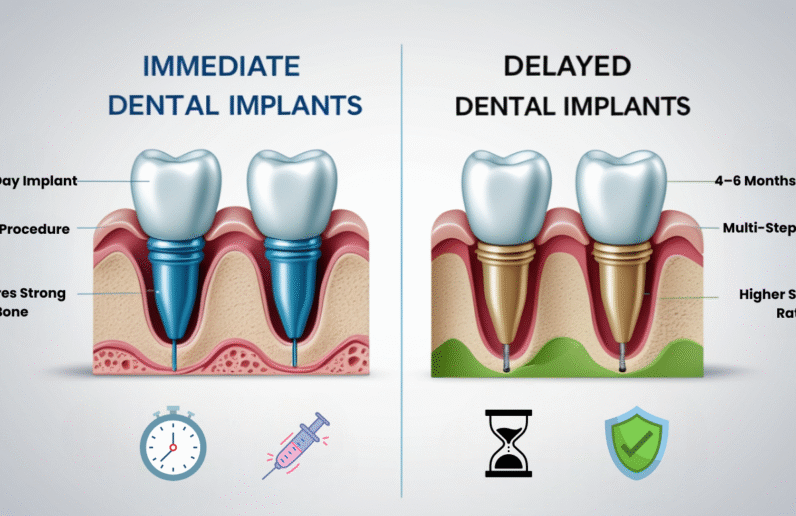
One of the most successful and widely accepted methods for restoring lost teeth today is dental implant treatment. However, one of the most critical decisions in this process is choosing the right timing for your implant, immediate loading vs delayed loading. Making the wrong choice could lead to a longer recovery, higher costs, or less-than-ideal results.
That’s why it’s essential to understand both options thoroughly from candidacy criteria to the potential trade-offs.
In this quick guide, we’ll explore the key factors that influence the choice between immediate and delayed dental implants. By weighing the benefits, risks, and suitability of each approach, you’ll be better equipped to make a confident decision that supports both your dental health and personal goals.
Immediate implant placement involves placing the dental implant right after tooth removal, often in the same appointment. This can be a faster and more effective approach, offering tooth replacement on the same day. Immediate implants are inserted directly into the socket right after a tooth is extracted, saving your time and reducing the number of visits.
However, ideal conditions are necessary for success. This approach works best when the socket walls are intact and there’s no active infection in the area. It’s not recommended for patients with certain health issues like poorly controlled diabetes, heavy smokers, or those with very thin gums. It’s most suitable for patients with strong, healthy bone structures.
If the extraction site is infected or significantly damaged, immediate implants are not advised. In such cases, the dentist will prioritize treating the infection and restoring the bone before considering an implant.
The dentist will take X-rays or 3D scans to check the condition of your bone and plan the treatment. If everything looks good, you may be a candidate for immediate implants.
During the same appointment, the damaged tooth is removed, and the implant is placed directly into the socket. This saves time and helps preserve the natural bone structure.
If the implant is very stable, the dentist may place a temporary crown or bridge right away. This means you won’t leave with a gap in your smile. However, you’ll be told to avoid chewing hard foods on that side to protect the implant while it heals.
Although you may have a temporary tooth, the implant still needs time to bond with the bone—this usually takes 3 to 4 months. You’ll have check-ups during this period to make sure everything is healing properly.
Once the implant is fully healed and secure, the dentist removes the temporary crown and places a permanent one that’s strong, comfortable, and matches your natural teeth.
Pros
Immediate Functionality: Immediate restoration allows patients to have immediate function, which means you can use your teeth again for chewing and talking with full confidence.
Faster Treatment: Tooth removal and implant placement both occur in one visit, reducing the overall treatment time.
Fewer Surgeries: Combining both extraction and implant placement in the same appointment, reduces the number of surgical procedures to be performed.
Cons
Higher risk of implant failure: Immediate loading depends on achieving high primary stability; if osseointegration is compromised, the implant may fail.
Not Suitable for Everyone: Patients with infections, insufficient bone, or certain health conditions may not be ideal candidates.
Delayed implant placement means the implant is inserted only after the extraction site has fully healed, typically 4 to 6 months later. This approach is ideal in cases of infection, significant bone loss, or when overall health requires a longer healing time. It’s also the better option when bone grafting is needed before implant placement.
Depending on the situation, the process can involve two or three stages, with healing periods in between to ensure proper osseointegration and reduce complications. This method is often chosen for its predictability and long-term success.
1. Tooth Extraction and Site Preparation
The compromised tooth is removed, and the socket is cleaned to prepare for future implant placement.
2. Bone Grafting (If Needed)
If the bone is too thin or soft, grafting material is added, often held in place with tiny screws or pins. This step is usually done immediately after extraction to allow healing before implant surgery.
3. Healing Period and Osseointegration
After extraction or grafting a healing interval of 3–6 months is taken to permit the extraction site to heal. During this phase, patients follow a soft‑food diet, avoid loading the site, and follow maintenance through hygiene of the site as prescribed by the dentist.
4. Implant Placement Surgery
After the area has healed, the dentist will place an implant (small titanium post) into the jawbone. This acts like the root of your future tooth. Your gums are then stitched up, and you’ll need to wait again for healing.
5. Osseointegration (Healing Period)
Over the next 3 to 6 months, your jawbone will grow around the implant in a process called osseointegration. This ensures the implant is securely attached, just like a natural tooth root.
At GM Dental, we provide both immediate and delayed dental implant solutions customised to suit your individual needs. Whether you’re an ideal candidate for same-day implants or require a more gradual approach due to bone loss or healing considerations, our experienced team is here to ensure your comfort, safety, and long-term success.
Using advanced diagnostic tools, we craft your implant journey with accuracy and care. This commitment to technology helps us deliver superior outcomes and lasting results.
Back to Blog“I have just had my dental implants fitted the whole procedure went really smooth,...”

“I had my dead tooth broken so implant was the only option to make...”
“I’ve been struggling with my teeth for many years and I’ve lost hope that...”
“My daughter attended this practice in 2010 and finished her treatment in 2013. The...”
“I was treated here years ago as a teenager and so did a few...”
“My daughter had her orthodontic treatment here over a 3 year period. Dr Coonar...”


* Smilevalley Limited trading as GM Dental and Implant Centre is an Appointed Representative of Chrysalis Finance Limited, which is authorised and regulated by the Financial Conduct Authority. Smilevalley Limited is a credit broker, not a lender. The provider of a payment scheme which is not offered through or by Chrysalis Finance Limited may not be so authorised and regulated.
* G Mehta Ltd trading as GM Dental and Implant Centre Rochester is authorised and regulated by the Financial Conduct Authority. Finance is arranged through Chrysalis Finance Limited. The provider of a payment scheme which is not offered through or by Chrysalis Finance Limited may not be so authorised and regulated.
* GMValley Limited trading as GM Dental & Implant Ashford is an Appointed Representative of Chrysalis Finance Limited, which is authorised and regulated by the Financial Conduct Authority. GMValley Limited is a credit broker, not a lender. The provider of a payment scheme which is not offered through or by Chrysalis Finance Limited may not be so authorised and regulated.