




 5.0
4.7
4.9
5.0
4.7
4.9
If you’re considering getting a dental implant, chances are you’ve already done some research. Maybe you’ve searched online, asked friends, or even asked your dentist a few questions. By now, you’re likely familiar with the basics: dental implants replace missing teeth and help restore your smile. But even if you feel well-informed, there are still quite a few lesser-known details that don’t always come up in a standard consultation or quick online search that could change the way you view dental implants.
In this blog, we’re sharing 8 surprising facts about dental implants that often go unnoticed but could give you a deeper understanding of how these advanced restorations work and what makes them truly unique.
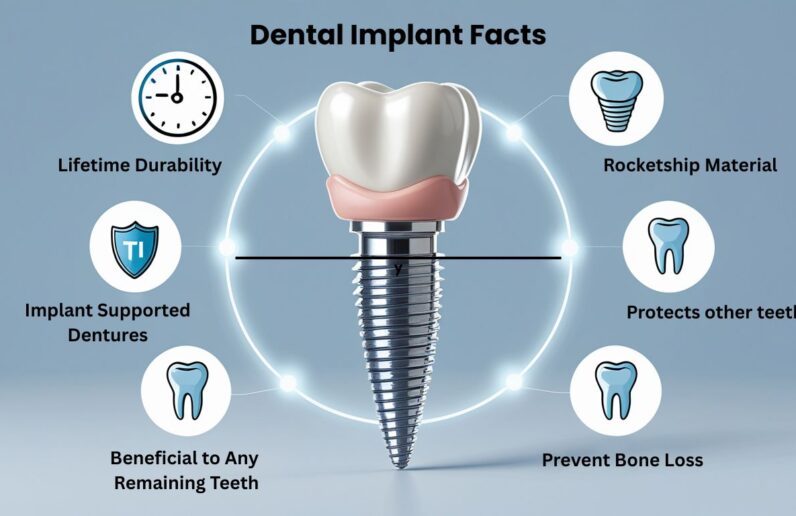
Dental implants are designed as a long-term and permanent solution for missing teeth. Unlike dentures or bridges, which may need replacement over time, implants can last 30 years or more with proper care. In fact, clinical studies show that dental implants have a success rate of over 95% even after 10 years. With regular brushing, flossing, and routine dental check-ups, many people enjoy their implants for decades, making them one of the most durable and reliable tooth-replacement options available.
It sounds surprising, but the metal used in many implants is the same metal NASA used in rockets. Dental implants are commonly made of titanium, a metal famous for its strength and lightweight. Titanium is used in the space program including space shuttles, missiles, and jet engines, because it is extremely strong and durable yet biocompatible. In dental implants, that means your new tooth root is made of a near-indestructible material. So not only is your implant safe in your mouth, it’s literally made of aerospace-grade material.
Unlike natural teeth, dental implants cannot decay because they have no enamel for bacteria to penetrate. Instead, implants consist of durable materials like titanium for the post and abutment, and porcelain or ceramic for the crown. These materials are not susceptible to bacterial damage.
However, while the implant itself won’t develop cavities, it’s still essential to brush and floss regularly. Good oral hygiene is crucial to keep your gums and surrounding natural teeth healthy. Without proper care, plaque buildup can lead to gum inflammation and bone loss around the implant. Consistent hygiene helps prevent these issues and ensures the long-term success of your dental implants.
Dental implants have significantly improved the comfort and stability of dentures. For individuals who already wear dentures, they can now upgrade to implant-supported dentures, a modern solution where the denture attaches directly to implants placed in the jawbone. In this system, multiple implants are surgically embedded into the bone, and the denture is either snapped onto or screwed into these implant posts. Screw-retained dentures are permanently fixed in place by your dentist and can only be removed professionally, while the snap-in dentures on the other hand can be removed for cleaning, they feel securely fixed while in place. This approach combines the full-arch restoration benefits of dentures with the stability and confidence of implants.
Since a dental implant functions independently, it doesn’t rely on neighbouring teeth for stability. Unlike a bridge, it fills the gap left by a missing tooth without grinding down or compromising neighbouring teeth. This helps preserve the strength and health of your natural teeth. Additionally, by occupying the empty space, the implant prevents nearby teeth from shifting or becoming misaligned. Overall, it helps maintain your bite structure and reduces unnecessary strain on the rest of your teeth.
A dental implant is made up of three essential components that work together to replace a missing tooth:
Dental implants are designed to function just like natural teeth and one of their biggest advantages is the ability to restore almost all of your original bite strength. Because the implant is securely anchored into the jawbone, it provides a stable foundation that is almost the same as the strength as a natural tooth. The crowns are also carefully shaped and precisely aligned with your bite, for balanced pressure across your teeth when chewing.
With this stability and support, you can return to a normal diet and enjoy hard or crunchy foods like raw vegetables, nuts, and crusty breads without fear of the implant shifting or breaking. Just be sure to wait at least a month or follow your dentist’s specific recommendations before reintroducing hard or sticky foods.
When a tooth is lost, the jawbone beneath it begins to shrink due to a lack of stimulation. Dental implants play the role of natural tooth roots by integrating with the bone and providing the necessary stimulation to keep it healthy. Implants are the only solution that actively prevents bone loss by restoring the natural function of a tooth root. This process, known as osseointegration, helps preserve jawbone density and structure. Research shows that individuals with implants experience significantly less bone loss compared to those with gaps or removable dentures. Maintaining bone supports your overall long-term oral health and helps retain your facial shape, preventing a sunken appearance and ensuring a strong foundation for surrounding teeth.
As you consider getting a dental implant, it’s important to be well-informed about the procedure. While implants are a safe and effective solution for most people, understanding the process can help you feel more confident and prepared. Dental implants not only restore your smile but also offer long-term benefits such as preventing bone loss, preserving facial structure, and providing a strong, natural-looking replacement for missing teeth.
If you’re thinking about dental implants, our team at GM Dental is here to help. We’ll guide you through every step of the treatment and ensure you receive the care and support you need for a healthy, lasting smile.
Back to Blog“I have just had my dental implants fitted the whole procedure went really smooth,...”

“I had my dead tooth broken so implant was the only option to make...”
“I’ve been struggling with my teeth for many years and I’ve lost hope that...”
“My daughter attended this practice in 2010 and finished her treatment in 2013. The...”
“I was treated here years ago as a teenager and so did a few...”
“My daughter had her orthodontic treatment here over a 3 year period. Dr Coonar...”


* Smilevalley Limited trading as GM Dental and Implant Centre is an Appointed Representative of Chrysalis Finance Limited, which is authorised and regulated by the Financial Conduct Authority. Smilevalley Limited is a credit broker, not a lender. The provider of a payment scheme which is not offered through or by Chrysalis Finance Limited may not be so authorised and regulated.
* G Mehta Ltd trading as GM Dental and Implant Centre Rochester is authorised and regulated by the Financial Conduct Authority. Finance is arranged through Chrysalis Finance Limited. The provider of a payment scheme which is not offered through or by Chrysalis Finance Limited may not be so authorised and regulated.
* GMValley Limited trading as GM Dental & Implant Ashford is an Appointed Representative of Chrysalis Finance Limited, which is authorised and regulated by the Financial Conduct Authority. GMValley Limited is a credit broker, not a lender. The provider of a payment scheme which is not offered through or by Chrysalis Finance Limited may not be so authorised and regulated.